Leviathan Gas Reservoir Projected to Hit Record $840 Million in Q3 Revenues
Leviathan natural gas reservoir projects record Q3 revenues of $840 million amid high oil prices and expanded export capacity, yielding $200 million for the state treasury.
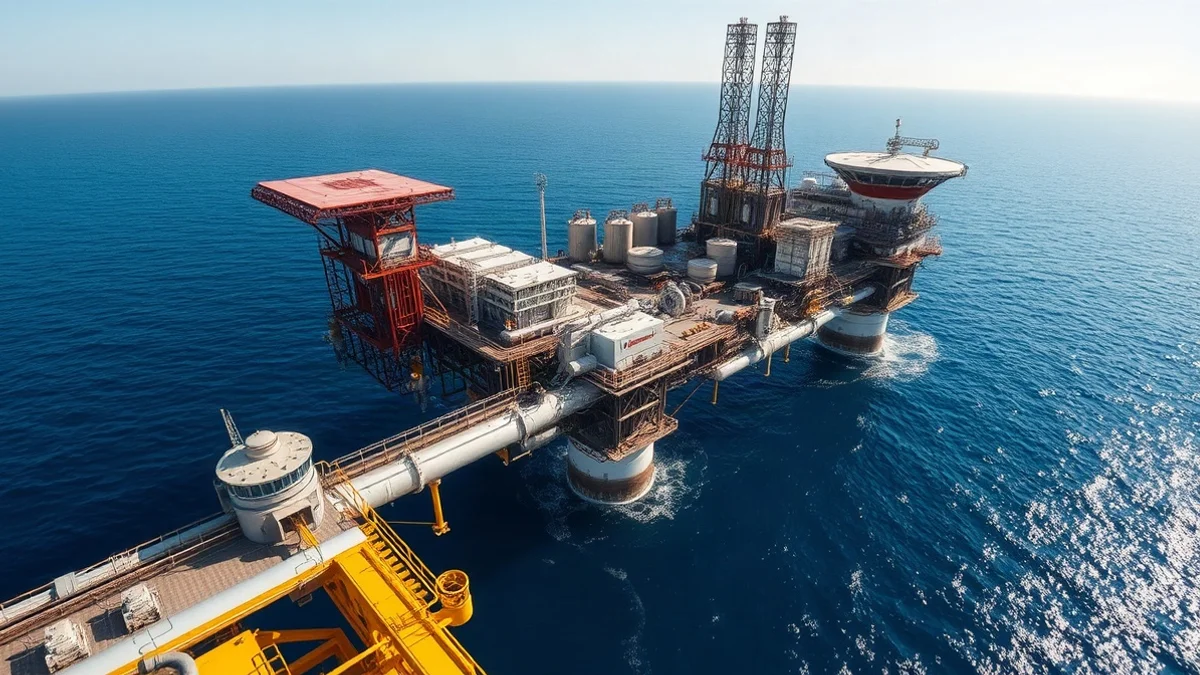
Driven by high oil prices and expanded export capacity, the Leviathan natural gas reservoir is projected to post record-breaking third-quarter revenues of approximately $840 million. Market estimates indicate that the state will rake in roughly $200 million from this single quarter. Meanwhile, the Tamar reservoir has also significantly boosted its production capabilities, with an export deal currently taking shape between some Tamar partners and Egypt.
The Leviathan reservoir remains the largest in the country and its primary exporter, servicing clients in Jordan and securing substantial deals in Egypt. As part of implementing the recent $35 billion gas supply agreement with Egypt, new export infrastructures are currently being established to route Israeli gas directly through pipelines. One such project was completed last July, immediately boosting export volumes. Furthermore, production capacity at Leviathan has been scaled up, though the primary bottleneck remains export infrastructure, which was expanded via the EMG pipeline by an additional 2 billion cubic meters (BCM) annually.
Export prices are determined via formulas tied to Brent crude oil averages from the preceding three months. During the third quarter, this average mirrored the second quarter, establishing a price of $6.55 per million BTU across Egypt, Jordan, and domestic markets. Multiplied by record sales volumes of roughly 3.5 BCM, revenues reach the estimated $840 million threshold, including condensate sales.
This projection remains relatively conservative, as expanding exports to Egypt could slightly elevate average prices compared to domestic rates. Local demand also experienced growth during this period. With Brent crude hovering around $110 per barrel, and barring unforeseen military disruptions, the fourth quarter could shatter existing records as well.
State Revenues and Taxation
The state is poised to capture significant financial gains from these record revenues. Roughly 10% of wellhead revenues flow directly to the state as royalties, independent of operational costs. Additionally, partner profits are subject to a standard 27% corporate tax rate, culminating in an estimated $200 million in tax revenues for a single quarter. To date, Leviathan has not yet triggered the surplus profits levy known as the Sheshinski tax, which applies only after full recovery of capital investments plus a designated return.
Leviathan is expected to begin paying the Sheshinski levy around 2028, with proceeds channeling directly into the national wealth fund for Israeli citizens. Ongoing capital investments and infrastructure expansions continually add to project costs, thereby delaying the threshold required for the surplus tax activation.
Conversely, the Tamar reservoir has already begun paying surplus profit levies and anticipates an exceptionally lucrative quarter. While Tamar is more heavily oriented toward the relatively inexpensive domestic market, roughly 40% of its gas is exported and pegged to Brent crude pricing. Tamar recently completed a major expansion, surging its production capacity from 10 BCM to 16 BCM annually, slightly eclipsing Leviathan's output capacity.
Future Horizons and Domestic Energy Challenges
Tamar partners are currently negotiating internal terms to join a massive export venture with Egypt, spearheaded by Isramco and Mubadala. Should all partners sign on, the cumulative valuation of the deal could reach $20 billion. Additional export arteries, such as the Nitzana pipeline and the FAJR project, are set to further widen Israel's export corridors.
On the domestic front, local energy demand is projected to surge due to the rapid proliferation of data centers, which are expected to consume up to 20% of Israel's total electricity output. These facilities are attracted to Israel by relatively affordable electricity prices, fueled by cheap domestic gas. However, this intensive consumption accelerates the depletion of natural reserves. Current projections indicate that unless renewable energy integration accelerates exponentially or major new gas fields are discovered, Israel may need to begin importing natural gas by 2048 to sustain its power grid.
Representatives for the Leviathan partnership declined to comment on the projections.