Behind the romance with Greece: "They understand that only Israel deters Turkey"
The "Achilles Shield" deal, revealed earlier this week, is making waves in Greek politics, and Health Minister Georgiadis defended it in parliament, arguing that the alliance with Israel protects against the "Turkish threat". Dr. Neta Bar explains that from the center-right to the far-right there is broad support for the agreement, while the Greek left is united mainly by hostility toward Israel. Against the backdrop of Erdogan's threats, Athens is looking to Jerusalem.
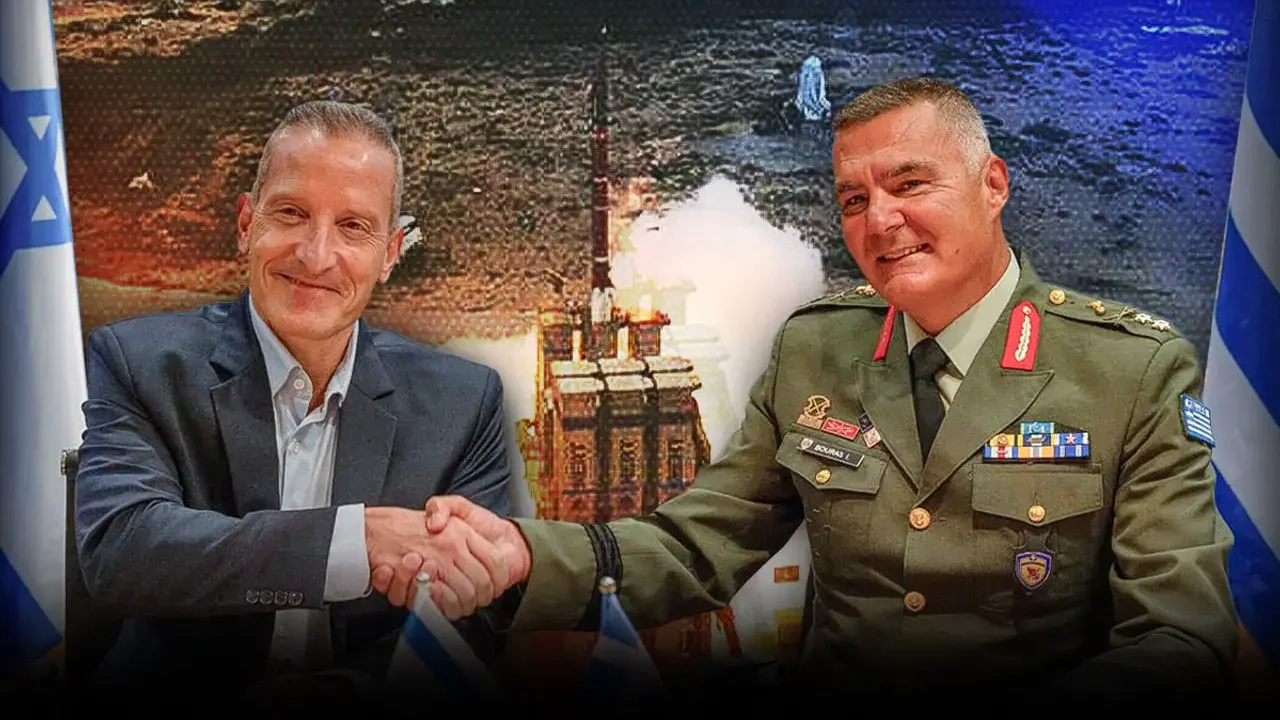
The "Achilles Shield" agreement was covered extensively in Israel due to the strategic dimension of close military cooperation with a European country that is a member of NATO. Reports on the details of the agreement, revealed earlier this week, are making waves in Greece and in the local political arena as well.
Greek Health Minister Adonis Georgiadis said in parliament that Greece's alliance with Israel protects against the "Turkish threat," and defended the deal for Israeli-made air defense systems, worth 3 to 3.5 billion euros, which was signed in Tel Aviv.
Georgiadis referred directly to criticism from the left, including summer protests by the Communist Party of Greece (KKE) against Israeli ships and tourists, which he called a "puppet theater." "We will continue this strategic alliance because it serves the interests of the Greek people, not the Soviet, communist, proletarian, or Palestinian people," he said. "We are here for the Greek people. And the Greek people see the alliance with Israel as a very important thing."
Dr. Neta Bar, from the University of Haifa and the University of California, Berkeley, explains that the Greek government's enthusiasm for the agreement is part of a military reform against the backdrop of a growing threat from Turkey. "The Greek army is undergoing a comprehensive reform under Defense Minister Nikos Dendias, and the very fact that one of the largest arms deals in Israel's history is only a part of it testifies to its depth," says Bar.
"Alongside similar deals with the USA, France, and Italy, the entire army is undergoing modernization. Although Israel is only part of the reform, its role is central. Not only does it have an air defense system whose effectiveness has been proven in battle, the alliance with us provides the Greeks with the 'back' they need. According to a survey published on liberal.gr, almost 80% of the Greek public recognize that the only thing Turkey is deterred by is Israeli military power, and therefore there is quite a consensus that they should join us," says Bar.
"The left is perceived as background noise"
The tightening of security ties marks a flourishing in relations between the countries. Alongside harsh criticism from the far-left, large parts of the political system support the deepening of ties with Israel.
"From the center-right to the far-right there is great support, and some are proud of the alliance. The Greek left is fragmented and lacks political power, even though it has electoral potential," says Bar. "The fact that the only thing the left can agree on is hostility toward Israel cannot overcome the center-right government of Kyriakos Mitsotakis, which has achieved exceptional successes. Since this is an objectively pro-Israel government, the opposition from the left is perceived as background noise, and even left-wing voters understand the advantages of an alliance with Israel."
It seems that the tightening of security relations is also creating a change in Greek public opinion. "According to a Pew Research Center survey, the Greek right is the most pro-Israel socio-demographic group in Europe. In the last decade, the sharpest declines in antisemitic attitudes ever measured in any country have been recorded in Greece," says Bar.
"At the same time, one must distinguish between the recognition that the alliance is beneficial and loving Mordechai. Although the balance leans slightly in favor of Israel, almost 60% testify that they have no preference and remain neutral. This is an Israeli achievement in a period when Israel's reputation is at an unprecedented low. I would not frame the situation as 'the Greeks love us,' but rather that we are in a very good trend."
An explicit threat
Turkey is making every effort to convince the Greeks that it is a threat. "Just this week Erdogan declared that 'Turkey is no longer the old Turkey.' He is promoting a concept known as neo-Ottomanism, an attempt to turn Turkey into an important empire, as it was in the days of the Ottoman Empire of the 17th century," says Bar. "The Greeks and Turks have never gotten along, but Turkish intentions today explicitly threaten Greek sovereignty. Beyond the 'Blue Homeland' plan, the parliament in Ankara declared that any Greek attempt to apply economic sovereignty in the Aegean Sea is a casus belli for Turkey."
Alongside hundreds of violations of Greek waters and airspace every year, Erdogan has warned the Greeks to 'remember Izmir,' a hint at the events of 1923. 'We may come to you suddenly at night,' he warned.
It seems that Turkey's long-standing membership in NATO does not work to calm the spirits in Athens. "Ironically, the mechanism that is supposed to curb hostility, the fact that both are members of NATO, is what scares the Greeks most. From past experience, every time the tone rose, the Americans intervened to reach a compromise that always came at the expense of the Greeks. They are very afraid that in exchange for industrial peace they will be forced to make painful concessions, such as transferring ownership of strategic islands."