Wall Street Faces AI Dilemma and High Interest Rates Amid Market Volatility
Wall Street faces a tense dilemma as tech stocks drop and inflation rises, forcing investors to weigh AI growth potential against a high-interest-rate environment.
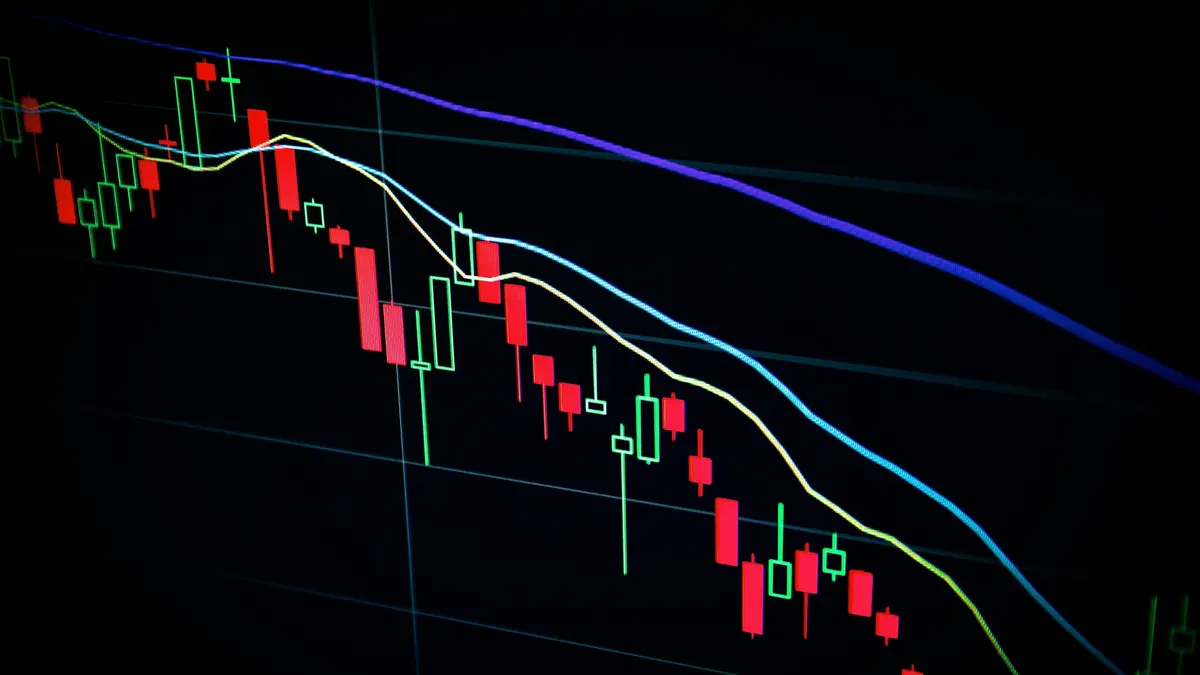
The recent sharp declines in technology stocks, coupled with persistent inflation data in the United States, are presenting Wall Street investors with a familiar yet unprecedentedly tense dilemma: does the current sell-off represent a convenient entry opportunity into the world's most growth-oriented sector, or is it the first crack of a prolonged bear market?
The Fed and Persistent Inflation
In the background lies the Federal Reserve's upcoming interest rate decision, as the Consumer Price Index rose in September to an annual rate of 3.7% (with core inflation at 2.6%), scrambling the cards. While markets were previously concerned with the timing of interest rate cuts, the possibility of a prolonged high-interest-rate environment—and perhaps even further monetary tightening—is now hovering over the market.
Three senior experts from the US capital market analyze this complex picture and mark the trends that will determine the direction of the investment portfolio.
Technology Stocks: The AI Proof Phase
Increasing volatility in tech giants raises concerns, but Paul Marino, Chief Revenue Officer at Themes ETFs, suggests looking at historical data before panicking. "Corrections are an integral part of any bull market cycle," Marino reminds, noting that since 1946, the median annual correction in the S&P 500 index has been around 11%.
According to him, a distinction must be made between declines stemming from deteriorating profitability or a credit crisis versus a correction resulting from the adjustment of interest rate expectations and risk pricing. He estimates that the fundamentals of tech giants remain solid, with strong cash flows and healthy balance sheets funding their operations. The demand for chips, data centers, cloud infrastructure, and artificial intelligence software continues to act as a multi-year growth engine.
Sylvia Jablonski, Chief Investment Officer at Defiance ETFs, agrees that the long-term trend is positive, but identifies a fundamental shift in market psychology: "The question is no longer how much money companies are pouring into AI, but when these massive investments will actually start generating profits and revenues on the ground."
Jablonski emphasizes that investors have become more suspicious of bloated capital expenditures (Capex) and are looking for a rapid return on investment. However, she maintains a bullish stance on chip companies, advanced memory, energy infrastructure, and power grid upgrades essential for operating AI servers, pointing to the quantum computing field as a promising long-term potential—though its risk level remains high.
The 5% Alternative: The Bond Market Pressures Equities
One of the main threats to the continuation of the stock market rally comes directly from the US government bond market. When government bonds trade around a 5% yield, they present an exceptionally attractive risk-free alternative.
Marino notes that the rise in yields stems not only from Fed policy, but from structural factors: the swelling government deficit and the administration's large borrowing needs, which force the market to demand a higher risk premium. These yields raise the discount rate and directly damage the valuation of growth companies, alongside increasing mortgage and business credit interest rates.
Jablonski clarifies a critical point for investors: a drop in bond yields will not necessarily be positive news for the stock market. "If yields fall because inflation is subsiding, the market will react positively. But if yields plunge as a result of a flight to safe-haven assets due to fears of a sharp slowdown or recession, it is a highly negative signal for the stock market."
The US Dollar: Weakening Momentum Amid Geopolitical Tensions
In the foreign exchange market, the US dollar continues to show strength, but its momentum appears to be reaching a ceiling. Violeta Todorova, senior research analyst at Leverage Shares, explains that the currency is mainly supported by interest rate differentials, energy prices, and its status as a safe haven during crises.
However, the fact that the US Dollar Index (DXY) retreated from the 102.94 mark shortly after the high inflation data indicates, in her view, a weakening of momentum. "The market has already priced in most monetary tightening scenarios. For the dollar to break out strongly upward, significant macro surprises will be required," Todorova argues.
Her baseline scenario points to a consolidation range of 100 to 102 points until the Fed announcement. Developments in the Middle East, with an emphasis on freedom of navigation in the Strait of Hormuz, may determine the direction: calm in maritime trade routes will lower the risk premium and weaken the dollar, while escalation will continue to fuel its power as a safe-haven currency.
A Week of Critical Tests
Markets are entering a trading week packed with sensitive economic indicators that could tip the scale:
-
Global Activity: Growth data in China and Purchasing Managers' Index (PMI) readings in the US and Europe.
-
US Debt and Macro Market: A 20-year government bond auction, housing market data, and weekly jobless claims.
-
Earnings Season: Results from tech giants, which will be required to prove that massive investments in AI infrastructure are indeed generating real growth in the bottom line.
Bottom line: experts agree that the technological revolution is far from exhausted, but the era of cheap money and automatic valuations has passed. As long as financing costs remain high, investors will be required to exercise rigorous selectivity, prioritizing companies with strong cash flow and a proven ability to convert technological promises into actual profitability.