Soaring on Air Currents Requires Less Energy Than Swimming, Study Finds
An international study published in Science reveals that soaring on air currents requires less energy than swimming, challenging lab assumptions. Researchers analyzed 17 years of data on birds and bats, showing large soaring species save immense energy.
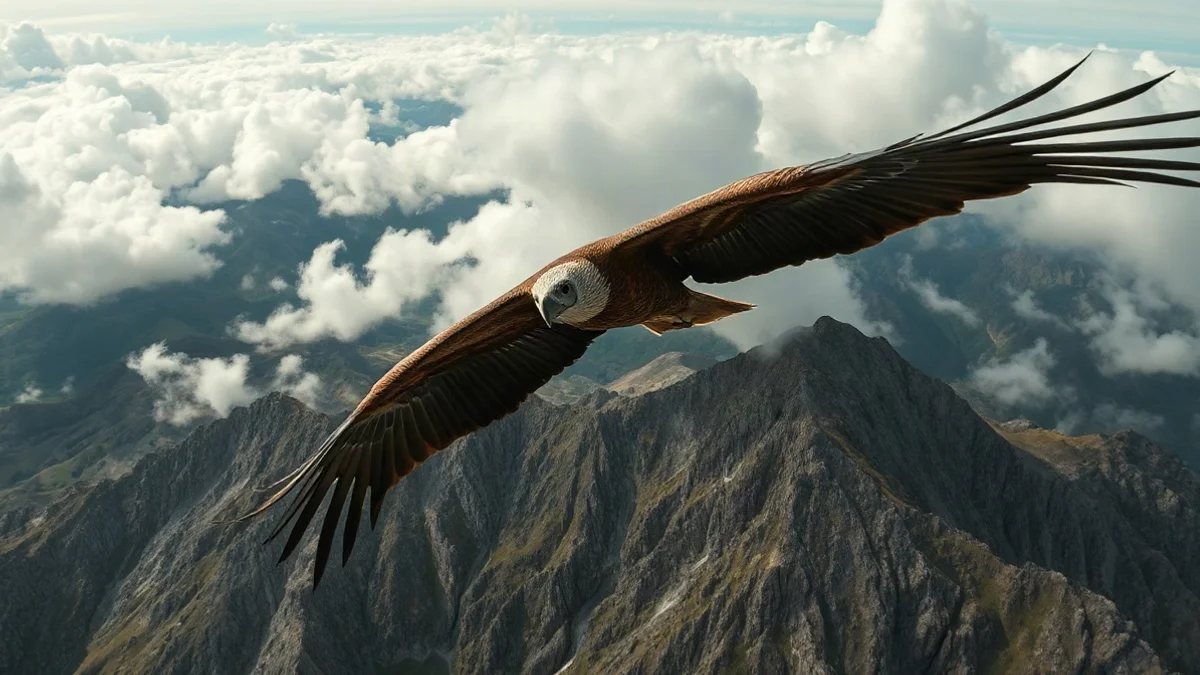
A recent international study published in the journal Science reveals that soaring using atmospheric air currents requires significantly less energy than swimming for animals of comparable weight. While traditional laboratory experiments have long suggested that swimming is more energy-efficient than flight, the new findings demonstrate that natural air currents completely alter this equation for soaring birds and bats.
GPS Tracking and Radar Analysis
Led by researchers from institutions worldwide, including Dr. Yuval Werber and Prof. Nir Sapir from the Department of Evolutionary and Environmental Biology and the Animal Flight Laboratory at the University of Haifa, the study combined GPS tracking and acceleration sensor data collected over 17 years from 850 birds and bats across 38 species. This dataset was integrated with four years of radar measurements, which allowed the team to monitor smaller animals that could not be fitted with tracking devices, ultimately covering weights from 12 grams to over 11 kilograms.
Dr. Werber and Prof. Sapir led the radar data analysis, which tracked wing-beating patterns across 12 weight-based groups. Researchers calculated the proportion of flight time spent flapping versus soaring, estimating total energy expenditure per distance based on environmental conditions and bioenergetic models.
The Andean Condor vs. The Trumpeter Swan
The findings highlight a dramatic disparity among birds of similar weight. The Andean condor (Vultur gryphus) requires about 79% less energy per kilometer of flight than a trumpeter swan (Trumpeter swan), despite both weighing roughly 11 kilograms. The condor flapped its wings during just 0.1% of the observed flight time, compared to 99% for the swan, resulting in an energy expenditure for the condor that was only one-fifth of the swan's.
As Prof. Emily Shepard from the Animal Movement Laboratory at Swansea University noted:
"When flying animals exploit natural atmospheric currents, they enjoy 'free fuel' from the skies. This research reveals the mistakes we make when we ignore the environmental conditions of the real world that animals have been responding to for millennia."
Ecological Trade-Offs of Flight Strategies
The study found that larger soaring birds flap less and consume less relative energy per kilometer as their body weight increases. Under optimal conditions, their energy consumption rivals or even undercuts the estimated costs of swimming for similarly sized fish. However, soaring relies entirely on favorable atmospheric conditions, restricting where and when these species can travel. Conversely, animals that rely on continuous wing-beating can navigate diverse conditions, though at a much higher metabolic cost.