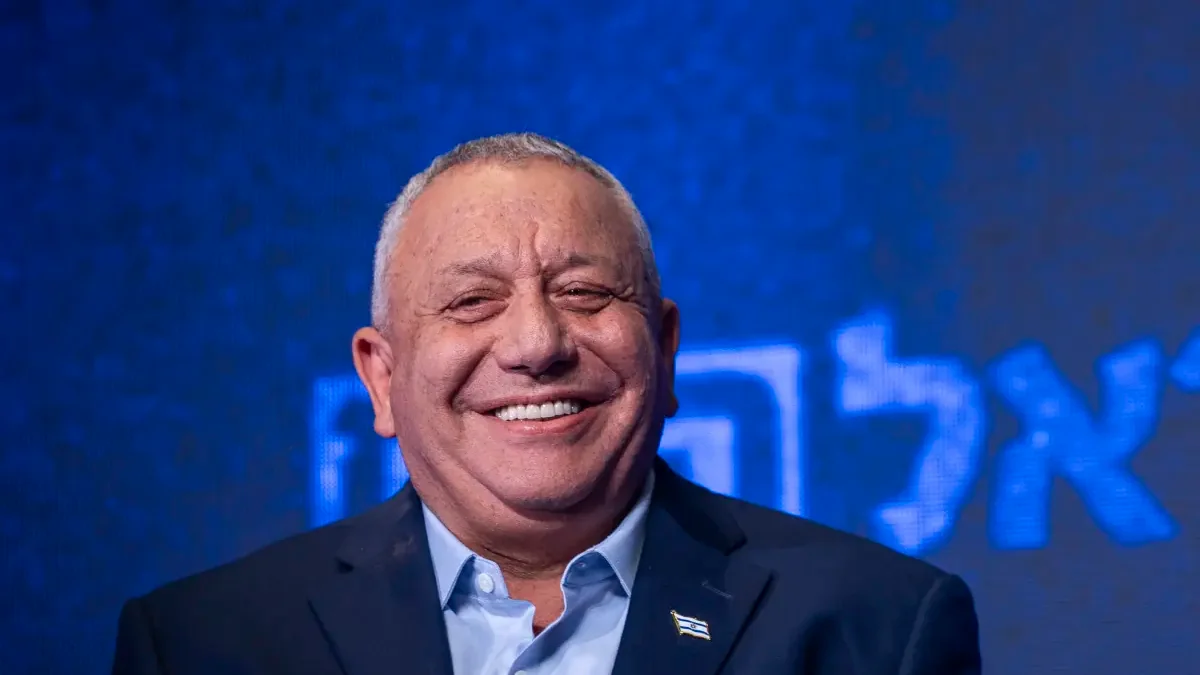
Yoav Kisch marked his next role in the government: "I want four years" | Special interview
In a special interview ahead of the start of the school year, Minister of Education Yoav Kisch summarizes his term, talks about the challenges the ongoing war has posed to the system, about his criticism of the Meitzav exam system, and explains why he fell in love with the role.
Over the past four years, Israel's students have learned how history is made. They experienced it firsthand in kindergarten and elementary school, in high school and in academia, in protests for and against, in cramped hotel rooms, in front of Zoom screens, under sirens, and in the shadow of concern for brothers and fathers at the front.
It is no wonder, then, that the large, cumbersome, and bureaucratic education system often operated in a first-aid format. "In November 2023, about a month or so after the war began, the first agreement for the return of the hostages was signed, and most of the children kidnapped to Gaza were released," says Minister of Education Yoav Kisch about one of the moments that symbolize the period under his management.
"The education system mobilized to prepare for the event. We held marathon discussions on how to absorb the children, how to support the families, and especially how to organize a supportive framework for them. It was very complex and challenging, and while working, I was updated that we had a parallel event: the State of Israel was required by Hamas to release juvenile offenders to East Jerusalem, and we had to ensure they did not return there as war heroes."
And you were in the middle. "It was very difficult in every respect. On one hand, we were looking for solutions to ease the burden on the hostages through adjustments and accompaniment in educational institutions, and on the other hand, we were looking for solutions to restrain the released ones so as not to create celebratory spectacles. And then I realized that when talking about the education system in the State of Israel, it is not just a kindergarten, high school, or school, but a space through which all the challenges of the State of Israel are distilled."
An unrewarding role
Ahead of the opening bell of the school year, Minister of Education Kisch seeks to shift the focus from crisis management to the full plan. From his perspective, no more fire-fighting, but the beginning of a new educational architecture. His vision for the next four years deals, among other things, with the question of what kind of world they are being prepared for, and it is based on deep rehabilitation alongside the future, innovation, and artificial intelligence.
"My moves consist of two legs," he says, "one is the acquisition of knowledge related to the new world, artificial intelligence, and scientific subjects. We have quite a bit of work there in light of the poor results we had in international exams. Artificial intelligence is a field that is going to change the rules all over the world, and it is clear to us that countries that manage to lead students in this field will prepare graduates for the challenges of life."
In what way? "The system will change and adapt to a situation where knowledge acquisition will take place through personalized learning with artificial intelligence. The State of Israel is one of the world leaders in integrating artificial intelligence into education, and as early as next year, we will start this program."
And the second leg? "Integrating special education into the regular education system. This is a subject very close to my heart. I have been working on it since the beginning of the term. The meaning is up to 20 students in a kindergarten or class, a transition to five days a week, and the integration of therapists into general education."
Why hasn't this happened until now? "Since the beginning of the war, we were not allowed to advance the program because it requires significant budgets and strategic legislation. Getting 15 billion shekels for education in war years is not realistic."
The Teachers' Union opposed this arrangement and demanded not to integrate more than two students with disabilities in one class. "It was a niche argument because the classes are larger, and therefore we found ourselves with more students. In the end, the objection was not accepted because the number of special students is determined according to a personal needs basket."
What else is in your plans for the next term? "I strongly believe in the subject of Jewish and Zionist identity. Therefore, I intend to continue acting in this field with all my might. Next year, a new subject, 'Heritage Paths', will be introduced to middle schools and high schools."
What will happen to these plans if you do not serve as Minister of Education in the next term? "I very much want to be the next Minister of Education of the State of Israel to complete this important move. It is indeed not an easy role. It is not rewarding in the media because there are always problems in classrooms and educational institutions, and the role of the media is to highlight them. But on the other hand, the ability to provide an answer and help Israel's students is a great mission. Not long ago, there was a CBS survey that checked parents' satisfaction with the education system, and despite the challenges of the war, the numbers were high. So I feel like a teacher who arrives in class, deals with the difficulty, but at the end of the day is excited about the mission because he influences the students' lives and their future."
If you are not the Minister of Education and someone else leads your vision? "There is a big difference if it will be a Minister of Education with a right-wing national orientation, or if it will be a Minister of Education with an orientation towards retreating from the national right. I fear there will be those who will not be interested in strengthening Jewish heritage, or will be afraid to take it forward, like some Ministers of Education who served before me."
Are you saying, in fact, that the success of a Minister of Education depends on his political orientation? "I think there is a connection between an educational agenda and a political orientation. I am not saying that someone will not give budgets to those who are not identified with him, but the emphases and direction might change."
You present an impressive vision for the next four years, but on the ground, there is a severe shortage of thousands of teachers, unprecedented erosion of teaching salaries, and a budget-shrunken system. How do you intend to fund and implement the reforms? "This is exactly the reason we could not put the vision into practice during the war. But ahead of the next term, we are going to change the situation and create a multi-year national plan that will bring tens of billions. We prepared the foundation in partnership with the Treasury, and I very much hope we can set out on a new path."
Naftali Bennett, himself a former Minister of Education, claims that "the Ministry of Education should be dismantled as a body that manages education in the State of Israel." "It is hard for me to hear these things from someone who claimed against me that I canceled his five-unit program. I filed a lawsuit against him because he himself canceled it as Prime Minister. In my eyes, this is the peak of populism. Regarding the program he proposes, it is interesting why he did not fulfill it himself while he was Minister of Education. Since I do not know the details, I cannot delve into and relate to his program."
There will be no strikes
The "Iron Swords" war diverted a significant portion of resources to provide for students and teaching staff from the North and South, and the Ministry of Education was one of the first ministries required to do so from the first day of the war. Alongside the war, Kisch led the establishment of the university in Kiryat Shmona, a move of academic anchoring precisely in an area that was damaged and whose residents were evacuated. "By virtue of my role as Chairman of the Council for Higher Education, we established three medical faculties in response to the crisis of the shortage of doctors," he says. "One of them is the international medical faculty in Eilat that opened this year, and I believe it will be a growth engine for the southern city."
What about studies in schools? "One of the most significant things was returning Bible studies to the forefront as a mandatory subject. We also added enrichment programs in the field of Jewish identity and secured a budget of 100 million shekels for them. Also in core subjects, we brought about a situation where 7th and 8th-grade students will learn English through artificial intelligence, and we also added financial learning with the understanding that proper economic conduct is one of the most significant tools for success. Another task I took upon myself was to remove mobile phones from classrooms in elementary schools. Next year, they will be prohibited for use in middle schools as well. All these achievements happened during the challenges of the war and in a difficult budgetary constraint. It was a joint effort, and I salute the teaching staff who were the Iron Dome of the Israeli home front throughout the period."
And what about academia? "Following legislation we promoted, 4,000 combat soldiers and reservists were accepted into academic programs for university learning, with concessions below the threshold conditions. Alongside this, we passed a decision against the politicization of academic institutions in the CHE. We managed a battle against the heads of academic institutions, some of whom have political presidents who tried to turn the institution itself into a political player."
What is the problem with expressing a political position by students or faculty in academia? "There is no problem with students or staff participating in a political protest or taking part in political activity. It is their full right to express themselves. The problem begins when a president decides to impose a political position on his institution. And I say, who are you, who are you to decide that because Ronen Bar is being fired, you are shutting down the university? When a president dictates a political line, he takes the entire institution hostage to his positions. The academic institution he heads is not his and not his mother's. Therefore, we introduced institutional neutrality."
During your term, the claim arose that the partisan and independent educational institutions of the Haredi society, which do not teach core subjects, are generously budgeted with coalition funds. "There is a very big gap between me and the Attorney General, who is the real opposition to this event. Her perceptions are very extreme in my eyes because we give 100% funding only to institutions that teach 100% core subjects. I am strict about the sentence, 'the depth of the core is the depth of the funding'. We even have a registry of all teachers and kindergarten teachers who do not teach a full core, things that didn't exist before. But the Attorney General says, if you don't have teachers qualified to teach core subjects, then Haredi educational institutions are not defined as those where core subjects are studied. And I say, what can you do, even in the state education system there is a great shortage of teachers, and we make adjustments, and therefore also in the Haredi world there are adjustments, and if you go out against them, it is discrimination."
If the teaching of core subjects is lacking, why do you certify the institutions that teach there in this way so that they receive budgets? "We invested a lot in strengthening state-Haredi education, it grew the most during my term, but I do not believe in a head-to-head war with parents and children in the Haredi society. You will not win against parents who will not send their children to places where they do not believe in the form of study there. So yes, there is a certain layer of institutions that do not teach 100% core subjects, and they are the subject of the discussion."
And those who do not teach core subjects at all? "They receive 55% of the budget. This is a decision of the court, which determined that we will not starve children in the State of Israel even if they are not willing to learn core subjects. In the end, I do the best I can within my budgetary framework in all complex areas, not just in core subjects. We will start the coming year successfully. There will be no strikes, and although I had to fight for budgets and reward teachers so they would be satisfied, there were always those who were hurt because that's how it is in a large system. But when I look at what we managed to do, and at how things could have looked different in the field of education, I feel pride and success."
Investigating the system
One of the central claims that arose during Kisch's period was that the Ministry of Education avoided continuous and transparent publication of data on the poor achievements in the Meitzav exams. Despite the attempt not to distribute the information, in practice, it was sent to school principals. According to the data, only 3% of Israel's 9th-grade students met the requirements of the curriculum, 16% were close to it, but 81% of the students were not close at all to the threshold set by the Ministry of Education.
"When I arrived at my position, there were no such exams at all," says Kisch. "And it was I who demanded them because I wanted there to be a real check so that we could learn lessons and improve. Unfortunately, there is a deep professional debate about the method of the exam. If it is written to 9th-grade students in science that this exam does not carry a grade, then it is clear that everyone will go out and will not bother to do it."
On the merits, the situation of Israel's students in mathematics and English is dire. "I believe that a strong and independent body is needed to investigate the education system so that it can learn the conclusions and improve. But first and foremost, one must ensure that the check is reliable and professional."
Another claim that arose was the expansion of the "New Horizon" program and the transfer of huge sums to Haredi education, including the Shas and United Torah Judaism education networks, without there being a condition of obligation, supervision, and enforcement of core subjects. "'New Horizon' did not come to fruition in the end because it was stopped and discussed in court. But the intention was to push the system forward, and if this move had taken place, it would have led Haredi teachers to academic education. It could have been a significant trigger for improvement."
Alongside the professional engagement in his ministry's affairs in such a difficult and stormy year, the personal, family aspect was integrated into Kisch's life. "My youngest son finished 12th grade this year," says the Minister of Education with emotion. "Therefore, at the end of the year, I felt that I was parting with another layer of the education system."
Ahead of the new school year, how do you summarize the past year? "I think it was characterized by very many difficult decisions. For example, the subject of matriculation exams and the decision on differential concessions for youth, which also had to pass the agreement of academia. And there was the deliberation on when to open the education system after the return to the South and also to the North. This is a strategic decision of the highest order. We did not always know the difficulties in advance until we encountered them in real-time."
He added: "I remember a 12th-grade student from one of the schools in the South called me. She told me: 'We are a shattered class. We have dead friends, a kidnapped teacher, and despite the pain and difficulty, because of all kinds of constraints, we currently do not have the ability to be together. So we ask you to concentrate us in a boarding school for the whole school year.' She asked that the system deviate from its decisions and show flexibility, and it touched my heart so much that I activated all the systems and the wonderful people who stand at their head, and within three weeks we connected the group to a boarding school in Ein Gedi and brought them a supporting envelope. They spent the whole year together, I was with them at the opening of the year and also at the graduation ceremony. There I realized that if we hadn't come to their aid, they would have been lost. What a privilege it is for a Minister of Education, to help precisely in these small cases that for students are a whole world."