Haredi Housing Boom Transforms Kiryat Gat and Ofakim Amid Shortages
A severe housing shortage of 12,000 units is driving massive ultra-Orthodox residential construction in Kiryat Gat and Ofakim, featuring tailored neighborhood planning, Shabbat elevators, and community infrastructure.
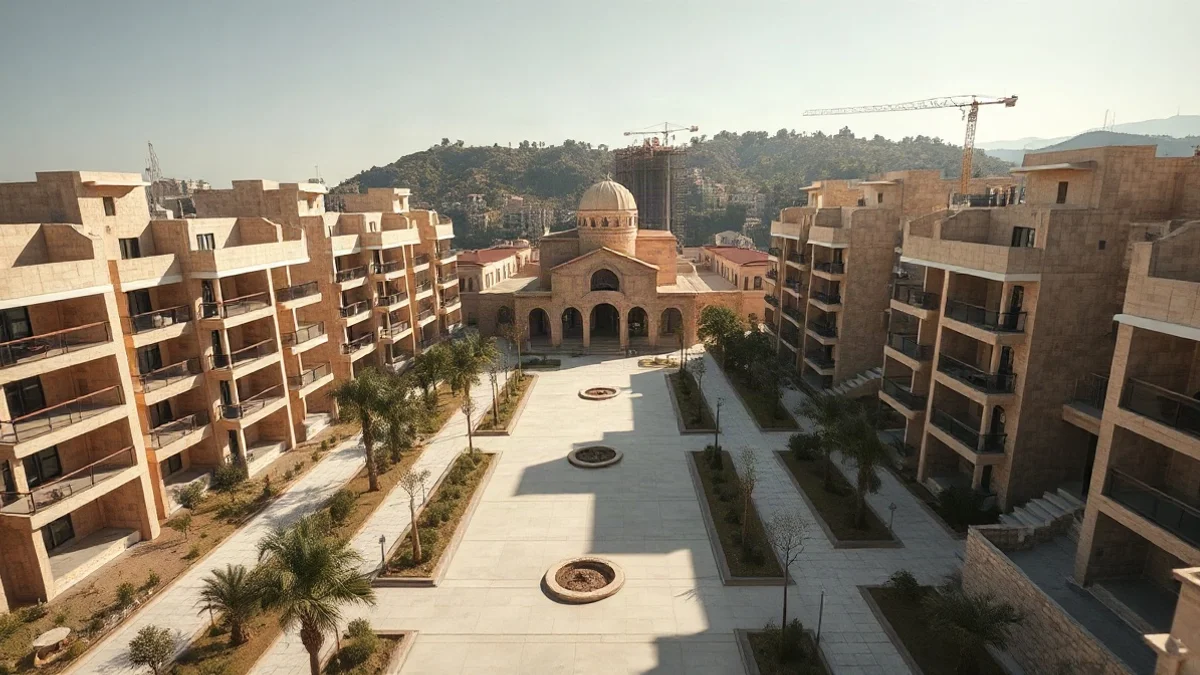
The severe housing shortage within the ultra-Orthodox community is driving new residential construction far beyond traditional strongholds like Bnei Brak, Jerusalem, Beit Shemesh, and Elad. Today, Kiryat Gat and Ofakim are emerging as major strategic destinations for developers seeking to meet the immense demand for more affordable apartments, alongside neighborhoods meticulously planned from inception to cater specifically to the religious lifestyle.
Kiryat Gat: The New Ultra-Orthodox Metropolis of the South
Kiryat Gat is currently undergoing one of the largest construction booms in Israel tailored for the ultra-Orthodox sector. At the heart of this development is the 'Ma'arava' quarter, situated in the western part of the city, which is slated to comprise approximately 7,500 housing units.
A defining characteristic of the quarter's master plan is the creation of a comprehensive community infrastructure. Plans include the construction of 80 synagogues, 10 ritual baths (mikvaot), 100 daycare classrooms, 200 Talmud Torah classrooms, 200 Beit Yaakov classrooms, 100 seminary classrooms, and 100 small yeshiva classrooms.
Prominent companies spearheading these projects include Reisdor, Rami Shビro, Sh. Baruch, Amram Abraham, Netanel Group, and Sh. Alroy. Furthermore, the district master plan approved by the National Planning and Building Council paves the way for a brand-new ultra-Orthodox metropolis adjacent to the western edge of the city. The overarching plan holds the potential for up to 40,000 housing units dedicated to the ultra-Orthodox public over the long term, with Phase A—encompassing about 11,350 units destined to house roughly 62,500 residents—approved for deposit in March 2026.
A Shortage of 12,000 Housing Units
According to Noam Greif, CEO of the Amram Abraham Group, which operates in ultra-Orthodox projects in Kiryat Gat, Beit Shemesh, and Jerusalem, there is currently a deficit of 12,000 housing units for the Haredi sector. 'I used to be the city engineer of Elad. From my experience as a municipal and committee engineer, people reached a point where they sealed off spaces inside parking lots and converted them into apartments,' he recounted.
'This happens simply because they have nowhere to live. It is not like the secular sector, where if a location doesn't suit you, you move to Hadera, and if not there, to Netanya. In the ultra-Orthodox sector, there are numerous issues involving communities, public buildings, distinct streams, and lifestyle-related constraints,' Greif explained.
This robust demand is clearly reflected in recent sales figures. According to Central Bureau of Statistics (CBS) data published recently, Kiryat Gat led Israel in new apartment sales between June and August, with 1,044 units sold.
According to Aryeh Netanel, chairman of Netanel Group—which secured two sites under the 'Target Price' (Mehir Matara) municipal tenders in the city—'For developers, the challenge is not just building a large number of apartments, but understanding the exact needs of the future population and translating them into correct architectural planning, ranging from apartment mixes and building structures to public institutions, public spaces, accessibility, and integration into the existing urban fabric.'
Designing a Haredi Neighborhood: Beyond Sukkah Balconies
Greif elaborates on the structural adjustments required for the ultra-Orthodox public: 'There are specific planning adaptations, such as Shabbat elevators, double kitchen sinks, rectangular rooms that accommodate two beds side by side, and Sukkah balconies, which are an essential prerequisite for Haredi buyers.'
At the same time, he notes, 'As a result of the severe housing shortage, there is greater flexibility and openness today toward living in high-rise towers, which some Haredi streams previously avoided due to reliance on Shabbat-programmed elevators.'
Extensive Public Institutions and Tailored Commerce
One of the most significant differences in planning ultra-Orthodox neighborhoods involves the sheer scope and variety of required public institutions. Alongside schools, kindergartens, and daycares, planners must factor in synagogues, mikvaot, study halls (batei midrash), and kollels, tailored to the various religious sub-factions.
Commerce in Haredi neighborhoods also evolves distinctively compared to general districts. According to Greif, while commercial centers elsewhere feature prominent fashion chains and brand-name restaurants, ultra-Orthodox neighborhoods place heavy emphasis on high-street shops, neighborhood retail, and grocery networks attuned directly to community needs.
Pricing Disparities: Kiryat Gat vs. Ofakim
Apartment prices vividly illustrate the wide gap between Kiryat Gat and traditional housing hubs. According to Greif, free-market apartment prices in the company's projects hover around 25,000 NIS per square meter. Consequently, a four-room apartment spanning roughly 100 square meters costs about 2.4 to 2.5 million NIS, while a five-room apartment of roughly 120 square meters reaches 2.8 to 3 million NIS.
Meanwhile, Ofakim offers a compelling alternative featuring an established Torah community alongside highly accessible housing prices and robust municipal tax benefits. In the eastern Afiki Nahal neighborhood, spanning some 7,500 housing units, several compounds have been earmarked for the ultra-Orthodox public under state-backed programs like Mehir Matara.
Sh. Baruch, a development firm winning local tenders, is promoting its Ofakim project under the 'Chaveruta' brand, having recently secured a building permit. The company holds a total of 261 housing units across two sites in the city. Ofakim boasts a stark price advantage, with prices averaging around 13,000 NIS per square meter, compared to 30,000 to 40,000 NIS per square meter in Jerusalem.